

Introduction
For years, healthcare providers measured their digital visibility through one lens: Google rankings.
If your clinic appeared on the first page for relevant searches, you were considered visible. If it did not, SEO became the solution.
That assumption is starting to break.
Today, patients are increasingly turning to AI-powered platforms such as ChatGPT, Gemini, and Perplexity to research symptoms, compare treatments, understand procedures, and even identify healthcare providers. Instead of scrolling through ten blue links, they are asking complete questions and receiving direct answers.
This shift is creating an entirely new challenge for clinics.
Many websites that perform reasonably well on Google are effectively invisible inside AI-generated search experiences. When that happens, your clinic is excluded from the conversation before a patient ever visits your website.
This is why Healthcare AI SEO is rapidly becoming a critical component of modern patient acquisition.
Because if AI cannot find, understand, or trust your clinic’s website, potential patients may never find it either.
Patients Are No Longer Searching the Way They Used To
The way people search for healthcare information has changed dramatically.
A few years ago, a prospective patient might type “best dermatologist in Delhi” or “hair transplant clinic near me” into Google and browse several websites before making a decision.
Today, many patients are asking much more specific questions.
They ask things like:
“What is the best treatment for acne scars?”
“Should I choose a hair transplant or PRP?”
“Which clinic specialises in advanced dental implants?”
Instead of searching through multiple websites themselves, they expect AI assistants to do the research and provide recommendations.
This shift toward conversational search is particularly significant in healthcare because medical decisions often involve uncertainty, education, and trust. Patients are looking for explanations, comparisons, and expert guidance before they ever book an appointment.
As a result, AI search for healthcare is becoming an increasingly important part of the patient journey.
The clinics that appear in these conversations gain visibility. The clinics that are not becoming harder to discover.
Why Your Clinic’s Website May Be Invisible to ChatGPT
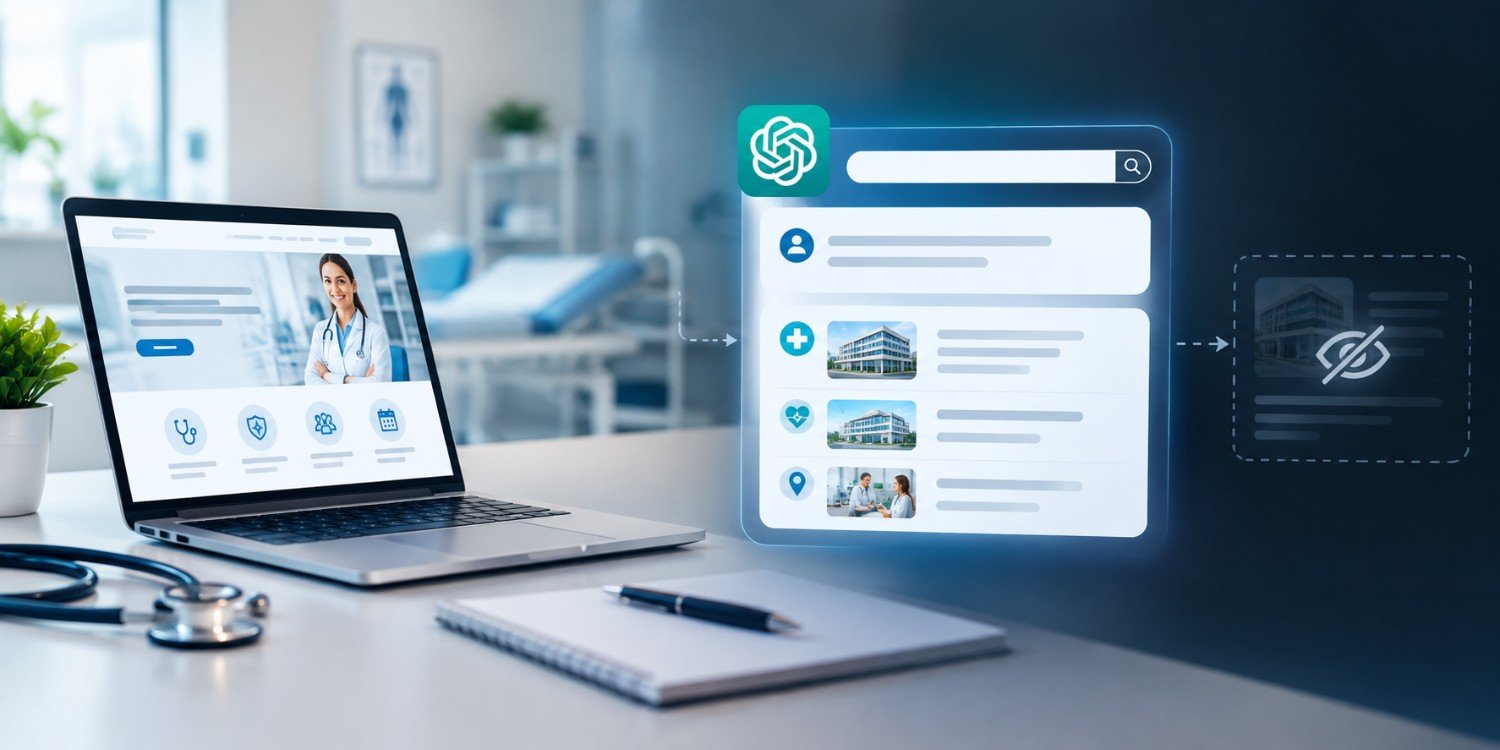
Many healthcare providers assume that if they have a website, AI platforms can automatically find and recommend them.
Unfortunately, that is not how modern AI search works.
Weak Content That Doesn’t Answer Patient Questions
One of the biggest reasons a clinic website becomes invisible to ChatGPT is a lack of meaningful content.
Many clinic websites consist primarily of service pages that provide basic information about treatments. While these pages explain what the clinic offers, they often fail to answer the questions patients are actively asking.
Patients want to understand recovery timelines, treatment suitability, costs, risks, alternatives, and expected outcomes.
Without educational blogs, FAQs, treatment guides, and condition-specific content, AI systems have very little context to work with.
The result is simple.
Your competitors become the source of information while your website becomes a digital brochure.
Poor Website Structure
Content alone is not enough.
AI platforms rely on structured information to understand websites effectively.
Missing schema markup, weak internal linking, confusing navigation, and poorly organised content can make it difficult for AI systems to interpret your expertise and services.
This is one reason why traditional Healthcare SEO and AI SEO for clinics increasingly overlap.
The easier your website is for machines to understand, the easier it becomes for AI platforms to reference and recommend your content.
Limited Online Authority
AI systems do not simply look at what your website says about itself.
They look at what the broader internet says about your clinic.
If your doctors are rarely mentioned on reputable healthcare websites, industry publications, news articles, medical directories, or trusted platforms, AI has fewer signals to validate your authority.
This creates a credibility gap.
Even excellent clinics can struggle to appear in ChatGPT healthcare search results if they lack external authority signals.
Outdated SEO Strategies
Many healthcare providers continue optimising exclusively for Google rankings.
While traditional SEO remains important, it is no longer sufficient on its own.
AI assistants evaluate information differently. They prioritise expertise, authority, trustworthiness, structured content, and citation quality rather than simply matching keywords.
This is where AI-powered search optimisation and GEO for healthcare websites become increasingly important.
Why AI Visibility Directly Impacts Patient Acquisition

The consequences of poor AI visibility extend far beyond search rankings.
Patient acquisition begins long before someone fills out a contact form or calls your clinic.
It begins during research.
When prospective patients ask AI platforms for treatment recommendations, provider comparisons, or healthcare guidance, they are actively shaping their shortlist of options.
If your clinic is absent during this stage, you lose visibility before the decision-making process even begins.
This can lead to fewer website visits, reduced brand awareness, lower trust signals, and ultimately fewer appointment inquiries.
Meanwhile, competing clinics that appear consistently in AI-generated responses gain an advantage with every interaction.
This is why modern patient acquisition strategy increasingly depends on visibility across both traditional search engines and AI-driven search experiences.
How Clinics Can Improve AI Visibility
The good news is that improving AI visibility follows many of the same principles that drive long-term digital authority.
The first step is publishing genuinely helpful content.
Comprehensive treatment guides, educational blogs, patient FAQs, and condition-specific resources help AI systems understand your expertise while simultaneously serving patient needs.
The second step is strengthening technical foundations.
A fast-loading, mobile-friendly website with structured data and clear architecture makes it easier for both search engines and AI systems to interpret your content accurately.
Building medical authority is equally important.
Detailed doctor profiles, patient testimonials, professional credentials, media mentions, and authoritative backlinks all contribute to stronger trust signals.
Finally, clinics must begin embracing GEO for healthcare websites, or Generative Engine Optimisation.
This involves creating content that AI systems can easily retrieve, understand, summarise, and cite. Clear headings, direct answers, factual accuracy, and regular updates all improve visibility in AI-generated search experiences.
Why Healthcare Marketing Needs an AI-First Strategy
Healthcare marketing is entering a new phase.
Patients are no longer relying solely on search engines to discover providers. They are increasingly relying on AI assistants to help them navigate healthcare decisions.
This does not mean traditional SEO is disappearing.
It means healthcare organisations must expand their approach.
The clinics that combine Healthcare SEO, local SEO, authority building, content marketing, and Healthcare AI SEO will be better positioned to capture visibility wherever patients search.
This is also why many providers are turning to a specialised healthcare marketing agency that understands both traditional search and emerging AI-driven discovery channels.
The goal is no longer just ranking.
The goal is to become visible wherever patients seek answers.
Conclusion
The future of healthcare search is becoming increasingly conversational.
Patients are asking questions, comparing providers, and researching treatments through AI platforms long before they visit a clinic website. If your practice is not visible within these emerging search experiences, you may be losing potential patients without ever realising it.
The solution is not abandoning traditional SEO.
The solution is expanding your visibility strategy to include AI search for healthcare, AI-powered search optimisation, and GEO for healthcare websites alongside proven digital marketing fundamentals.
At TZS DIGITAL, we help healthcare brands build future-ready visibility systems that combine SEO, GEO, content strategy, local search optimisation, and patient acquisition frameworks. Our approach ensures clinics are not only discoverable on Google but also positioned to appear where the next generation of healthcare decisions is increasingly being made.
FAQ’s
1. What is AI SEO for healthcare websites?
AI SEO for healthcare websites is the process of optimizing a clinic’s online presence so that AI-powered search platforms such as ChatGPT, Gemini, and Perplexity can easily understand, retrieve, and recommend its content. It combines traditional SEO with AI-focused content and authority-building strategies.
2. How does Generative Engine Optimization (GEO) help clinics?
Generative Engine Optimization (GEO) helps clinics improve their visibility in AI-generated responses by creating content that is structured, authoritative, and easy for AI systems to interpret. This increases the chances of a clinic being referenced when patients ask healthcare-related questions.
3. Can AI visibility increase patient appointments?
Yes. Strong visibility across AI search for healthcare platforms can improve awareness, build trust earlier in the patient journey, and increase the likelihood of patients visiting your website or booking a consultation.
4. What type of content helps clinics appear in AI search results?
Patient-focused content performs best. Treatment guides, FAQs, condition-specific articles, procedure comparisons, doctor profiles, and educational resources help AI systems understand your expertise and improve visibility in ChatGPT healthcare search and other AI-driven platforms.
5. Why can’t ChatGPT find my clinic’s website?
A clinic may be invisible to AI search because of weak content, poor website structure, limited online authority, outdated SEO practices, or a lack of trusted mentions across the web. If AI systems cannot confidently understand or verify your expertise, they are less likely to recommend your clinic.
6. Does ranking on Google guarantee visibility in ChatGPT?
No. While strong Google rankings are helpful, they do not automatically translate into AI visibility. Healthcare AI SEO requires additional focus on content quality, authority signals, structured data, and AI-friendly content formats to improve visibility across AI-powered search platforms.
