

Introduction
A few years ago, the goal of most D2C brands was straightforward. Build a great product, drive traffic to your website, acquire customers, and gradually increase repeat purchases.
Today, the rules are changing.
Platforms like Blinkit, Zepto, and Instamart have fundamentally altered consumer expectations. Customers who once waited two or three days for delivery now expect products to arrive within minutes. Convenience has become a competitive advantage, and speed has become part of the buying decision.
As a result, D2C brands on quick commerce have become one of the biggest trends in India’s consumer ecosystem.
Almost every founder is asking the same question: Should we be in quick commerce?
The answer is not as obvious as it seems.
On one hand, quick commerce offers unprecedented access to customers, faster product discovery, and significant growth opportunities. On the other hand, it introduces challenges around margins, customer ownership, and brand differentiation that many businesses underestimate.
The real question is not whether quick commerce works.
The real question is whether your brand can grow through it without becoming dependent on it.
Why Every D2C Brand Wants a Place on Quick Commerce

The rise of quick commerce for D2C brands is largely driven by changing consumer behaviour.
Customers increasingly prioritise convenience over almost everything else. When products can be delivered in ten or fifteen minutes, the traditional e-commerce advantage of selection and assortment begins to matter less.
This shift has created a new kind of shopping behaviour. Many purchases are no longer planned. They are spontaneous.
A consumer sees a need, opens an app, and completes the transaction within minutes.
For emerging brands, this behaviour creates an attractive opportunity. Instead of investing heavily in awareness campaigns, they can gain immediate visibility inside platforms that already have millions of active users.
The appeal is obvious.
Quick commerce offers access to customers who may never have discovered the brand otherwise.
For many founders, this looks like an efficient shortcut to scale.
The Biggest Opportunities for D2C Brands
One reason D2C brands on quick commerce are growing rapidly is that the channel can accelerate market expansion.
Traditionally, entering a new city required distribution networks, retail partnerships, or substantial marketing investment. Quick commerce platforms reduce many of those barriers by providing immediate access to local demand.
Another significant advantage is product trial.
Customers browsing quick commerce apps are often more willing to experiment with unfamiliar brands, especially in categories such as snacks, beverages, personal care products, supplements, and household essentials.
This lowers the friction associated with first-time purchases and can help brands acquire customers faster than through traditional ecommerce channels.
For products with high repeat-purchase potential, the benefits become even more compelling.
Consumers who rely on convenience often reorder through the same platform repeatedly, creating opportunities for consistent revenue generation.
Perhaps the most overlooked benefit is access to demand intelligence.
Quick commerce platforms generate valuable insights around buying behaviour, regional preferences, purchase frequency, and SKU performance. These insights can strengthen a broader D2C growth strategy when used correctly.
The Hidden Risks Nobody Talks About
While the opportunities are attractive, many brands fail to account for the trade-offs.
The first challenge is margin pressure.
Most quick commerce platforms charge commissions, require promotional participation, and create expectations around competitive pricing. By the time delivery costs, discounts, and platform fees are factored in, profitability can become significantly lower than expected.
The second challenge is brand visibility.
Ironically, while platforms increase product visibility, they can reduce brand recall.
Customers often remember where they bought the product rather than which brand they purchased. The platform becomes the hero of the experience, while the brand becomes a commodity.
This creates a dangerous dynamic.
Brands gain distribution but lose direct influence over the customer relationship.
Another major concern is customer ownership.
Unlike a direct-to-consumer website, quick commerce platforms rarely provide meaningful first-party customer data. Brands know what sold, but they often have limited visibility into who bought it, why they bought it, or how to communicate with them in the future.
This makes long-term D2C customer acquisition and retention more difficult.
When Quick Commerce Becomes Brand Suicide
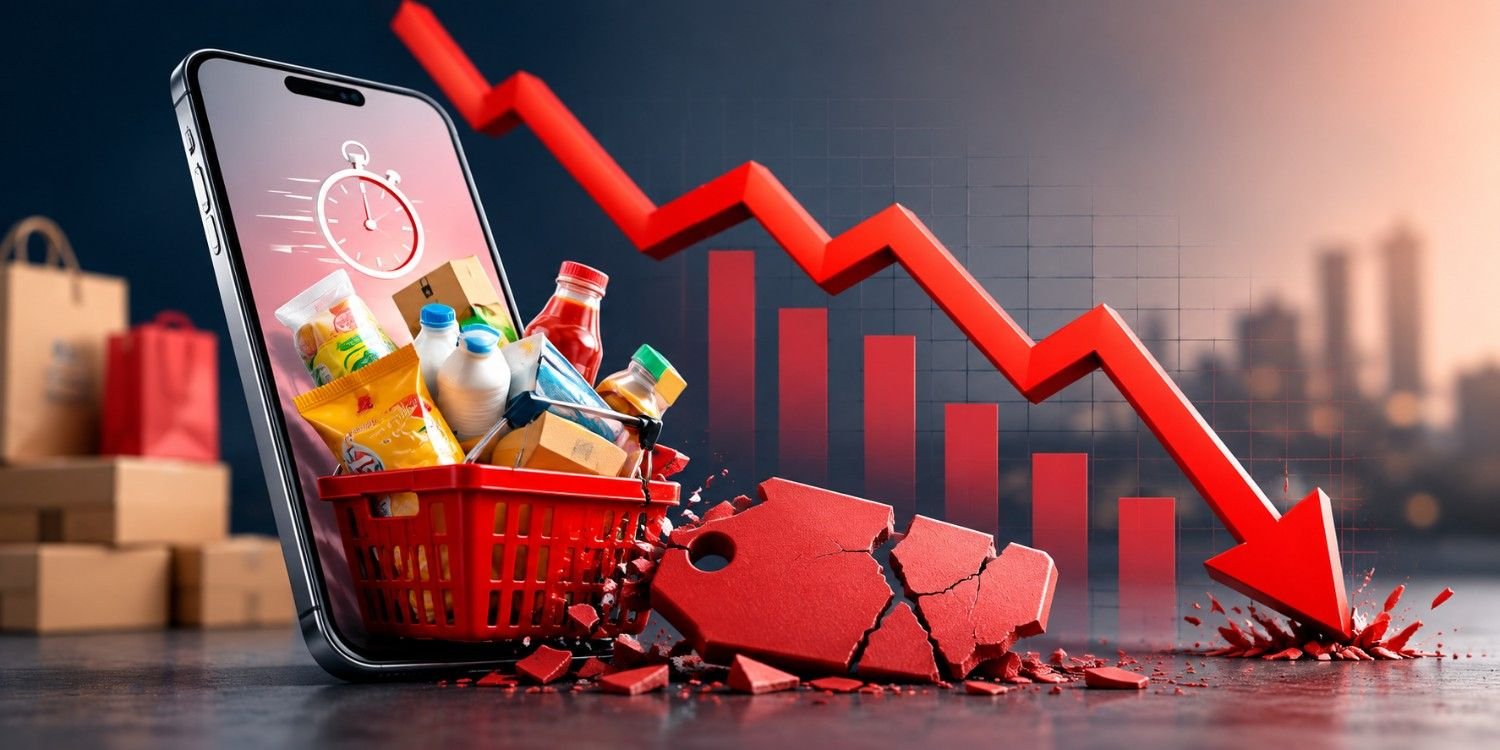
Quick commerce itself is not the problem.
Dependence is.
The biggest risk emerges when a brand begins treating quick commerce as its entire growth strategy rather than one component of a broader ecosystem.
The warning signs are usually easy to spot.
Revenue becomes concentrated on marketplace platforms. Website traffic stagnates. Customer retention efforts weaken. Marketing investments focus entirely on platform performance instead of brand building.
Over time, the brand becomes increasingly vulnerable.
If platform algorithms change, commissions increase, or competitors offer deeper discounts, growth can slow almost overnight.
At that point, the business is no longer controlling its own destiny.
The platform is.
This is where quick commerce vs e-commerce becomes an important strategic discussion. E-commerce allows brands to own customer relationships, collect first-party data, and build loyalty. Quick commerce prioritises convenience and reach.
Both channels matter.
The mistake is choosing one at the expense of the other.
Common Mistakes D2C Brands Make on Quick Commerce
Many brands rush into quick commerce without developing a clear strategy.
One common mistake is entering the channel without understanding unit economics. Sales growth may look impressive on paper while profitability quietly deteriorates in the background.
Another mistake is becoming overly reliant on a single platform. Concentration risk increases significantly when one marketplace drives the majority of revenue.
Many brands also neglect retention.
They focus heavily on acquiring first-time buyers but fail to create reasons for customers to remember the brand after the transaction.
Poor inventory planning can also damage performance. Stockouts, delayed replenishment, and inconsistent availability reduce both visibility and sales momentum.
Perhaps the most damaging mistake is competing solely on price.
Once a brand enters a discount-driven race, differentiation becomes increasingly difficult.
How Successful D2C Brands Use Quick Commerce the Right Way
The most successful D2C quick commerce strategy treats quick commerce as a growth channel, not a business model.
These brands build omnichannel ecosystems where marketplaces, websites, retail partnerships, and social commerce work together rather than compete with one another.
Many leading brands reserve premium products, exclusive bundles, subscriptions, and limited-edition launches for their own websites. This gives customers a reason to engage directly with the brand beyond marketplace transactions.
They also continue investing heavily in D2C marketing strategy initiatives such as influencer collaborations, content marketing, performance advertising, and community building.
This ensures that demand originates from the brand itself rather than being entirely dependent on platform traffic.
Most importantly, they focus on customer lifetime value rather than immediate sales.
The goal is not simply to sell a product through quick commerce.
The goal is to create a customer who actively seeks out the brand in the future.
That distinction changes everything.
Conclusion: Opportunity or Brand Suicide?
Quick commerce is neither a miracle growth channel nor a threat to be avoided.
It is a powerful distribution mechanism that can accelerate growth when used strategically.
For many D2C brands on quick commerce, the opportunity lies in faster discovery, wider reach, and increased trial. However, the risks emerge when brands become overly dependent on platforms, sacrifice margins, or neglect direct customer relationships.
The winners will not be the brands with the deepest discounts.
They will be the brands that balance marketplace visibility with strong brand equity, customer loyalty, and sustainable profitability.
At TZS DIGITAL, we help D2C businesses build growth systems that go beyond channel dependency. By combining performance marketing, brand strategy, retention frameworks, and customer acquisition systems, we help brands scale across marketplaces while strengthening their direct-to-consumer foundations.
Because sustainable growth does not come from selling wherever customers shop.
It comes from ensuring customers remember your brand long after the purchase.
FAQs
What is quick commerce for D2C brands?
Quick commerce for D2C brands refers to selling products through ultra-fast delivery platforms such as Blinkit, Zepto, and Instamart, where customers receive products within minutes rather than days.
Is quick commerce profitable for D2C businesses?
It can be profitable, but success depends on product margins, pricing strategy, inventory management, and platform economics. Brands that understand their unit economics tend to perform better.
Which products perform best on quick commerce platforms?
Products with frequent purchase cycles, immediate need, or impulse-buy potential typically perform best. Categories such as food, beverages, personal care, household essentials, and supplements often see strong demand.
What are the biggest challenges of selling through quick commerce?
The biggest challenges include margin pressure, limited customer ownership, platform dependency, discount expectations, and difficulty building long-term brand loyalty.
Does quick commerce reduce customer loyalty to D2C brands?
It can if brands rely entirely on marketplaces. Customers may remember the platform rather than the brand. This is why strong branding and retention strategies remain critical.
How can D2C brands maintain profitability on quick commerce platforms?
Brands can improve profitability by optimising pricing, managing inventory effectively, reducing discount dependency, focusing on high-margin SKUs, and maintaining a balanced omnichannel D2C growth strategy rather than relying solely on quick commerce.
