

When Your Content Looks Successful, but Your Business Doesn’t
There is a familiar situation inside many D2C businesses.
A Reel gets 200,000 views. Another post receives thousands of likes. Comments are pouring in, followers are growing, and the social media dashboard looks healthier every month.
Then someone asks the uncomfortable question: “How much revenue did all of this actually generate?”
Suddenly, the picture is less impressive.
This is the engagement-to-revenue gap, and it is one of the most overlooked problems in D2C content marketing today. The issue is not that engagement is useless. The issue is that attention and purchase intent are not the same thing.
A person can watch a product video, share it with a friend, and still have absolutely no intention of buying.
The job of content, therefore, is not simply to make people stop scrolling. A strong D2C marketing strategy must turn attention into interest, interest into consideration, and consideration into a buying decision.
That is where content starts becoming a growth asset rather than a social media activity.
Why High Engagement Doesn’t Always Mean High Purchase Intent
Engagement tells you that something caught someone’s attention. It does not tell you whether that person is a qualified potential customer.
A funny Reel may attract thousands of people because it is entertaining. An inspirational post may be widely shared because it is relatable. Even educational content can generate significant engagement from people who are simply curious about the topic.
None of that necessarily creates demand for your product.
This distinction matters because brands often optimise their D2C ecommerce marketing around metrics that are easy to see rather than metrics that explain commercial impact.
Likes, impressions, views, shares, and follower growth have their place. But if those numbers are rising while product-page visits, add-to-cart rates, purchases, and revenue remain flat, the content engine is producing attention without enough commercial intent.
A better way to evaluate content marketing performance is to follow what happens after engagement.
Did the person visit a product page? Did they explore another product? Did they add something to cart? Did they purchase? What was the revenue per visitor? What did it cost to acquire that customer?
Those questions reveal whether content is actually participating in growth.
The Missing Link Between Content and the Buying Journey

The biggest mistake in many ecommerce content strategy plans is treating every customer as if they are at the same point in the buying journey.
They are not.
Someone discovering your brand for the first time needs a very different message from someone who has visited your product page three times but still has not purchased.
At the awareness stage, educational content, short-form videos, cultural moments, and problem-led storytelling can introduce the brand and create relevance.
During consideration, consumers need more substance. Product demonstrations, comparisons, use cases, ingredient or material explanations, and expert perspectives help them understand why your product deserves attention.
During evaluation, trust becomes more important. Reviews, testimonials, FAQs, creator experiences, guarantees, and objection-handling content help reduce the uncertainty that often prevents a purchase.
Then comes the decision stage. This is where product benefits, offers, bundles, urgency, availability, and clear calls to action can move an interested consumer toward checkout.
After purchase, the job changes again. UGC, onboarding, loyalty content, email, and personalised recommendations can turn a first purchase into a repeat relationship.
This is why effective content marketing for ecommerce cannot be built around a calendar of disconnected posts. Content needs to perform different jobs at different moments.
Five Content Problems That Create the Engagement-to-Revenue Gap
1. Your Content Is Optimised for Attention, Not Buyers
The easiest way to increase engagement is often to make content broadly appealing.
The problem is that broad appeal can dilute commercial relevance.
If your content attracts millions of people who have no reason to buy your product, the engagement number looks fantastic while your customer acquisition economics get worse.
The better question is not, “How many people watched this?”
It is, “Did the right people watch this, and what did they do next?”
2. There Is No Strong Connection Between Content and Product
A consumer may love your content and still have no idea what they are supposed to do with that interest.
This happens when brands treat content and commerce as separate functions.
Every content pillar does not need to sell aggressively, but it should have a logical relationship with the product. If you are talking about a problem your product solves, the audience should be able to understand how your product fits into that solution.
That bridge is what turns attention into intent.
3. The Content Avoids Commercial Questions
Many brands are comfortable talking about lifestyle, trends, and inspiration but become hesitant when the conversation gets closer to purchase.
Yet this is exactly where consumers need help.
Why is this product better? Who is it for? Is it worth the price? How does it compare with alternatives? How long will it last? What happens if I do not like it?
Content that answers these questions can be far more commercially valuable than content that simply generates comments.
4. The Call to Action Comes Too Late—or Not at All
“Learn more” is not always a meaningful next step.
A strong CTA should match the consumer’s intent.
Someone discovering a problem may need to “See how it works.” Someone comparing products may need to “Compare the two.” Someone already familiar with the product may be ready to “Shop the collection.”
The closer the CTA is to the consumer’s actual decision, the lower the friction between content and commerce.
5. Nobody Measures What Happens After Engagement
This is perhaps the biggest problem.
If the marketing team reports engagement but nobody tracks what happens after that engagement, there is no way to understand the real content conversion rate.
A serious content operation should connect content performance with product-page visits, add-to-cart behaviour, purchases, revenue, customer acquisition cost, and eventually customer lifetime value.
That is how content moves from a creative expense to a measurable growth channel.
How to Turn Engagement Into Buying Intent
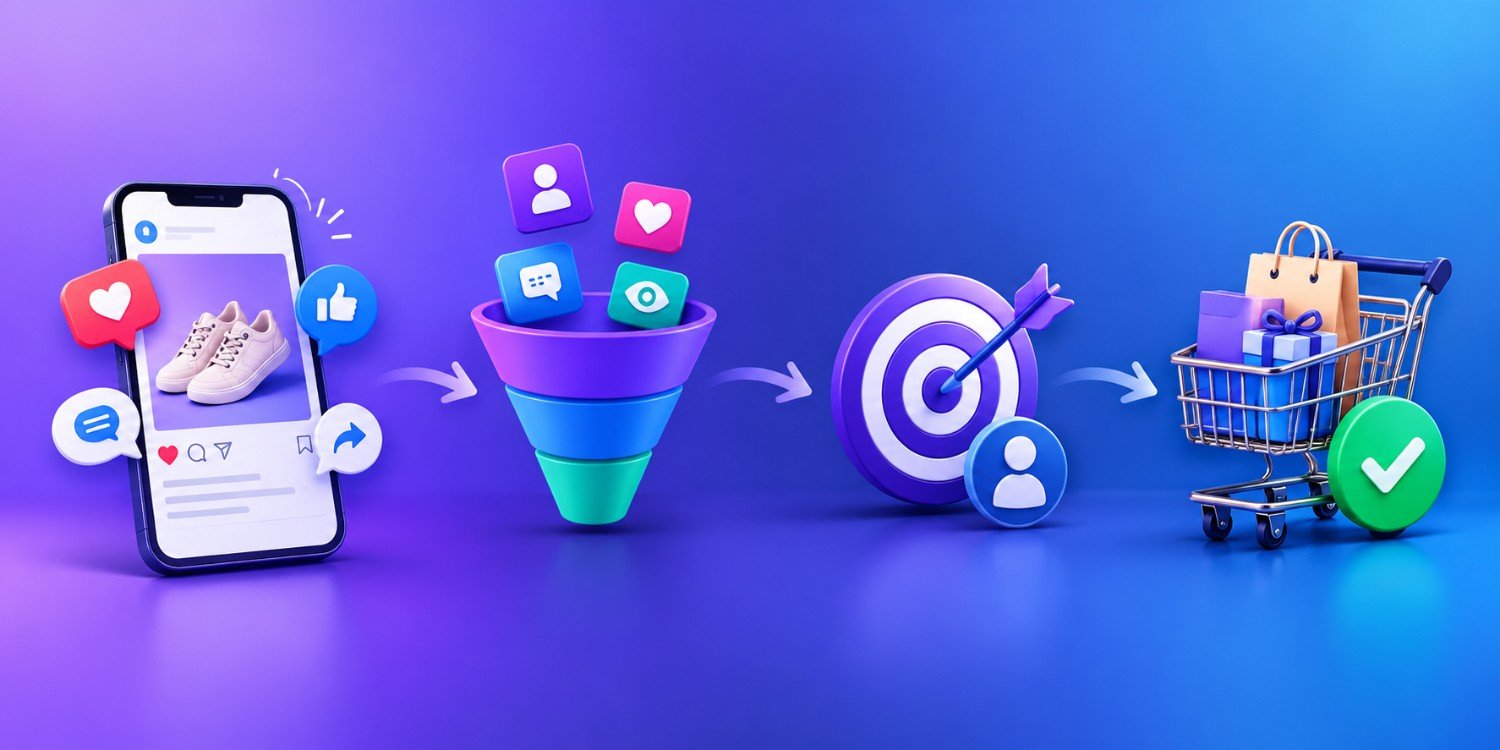
The solution is not to turn every Instagram post into an advertisement.
That would simply replace one problem with another.
Instead, build content around real customer problems and connect those problems naturally to your product.
If customers hesitate because they do not understand the difference between two options, create comparison content. If they worry about whether the product is suitable for them, create educational content that answers that concern. If trust is the barrier, use customer experiences, reviews, demonstrations, and credible proof.
Then connect each piece to the most relevant product page or landing page.
Retarget people who engage but do not purchase, and avoid treating every interaction as an isolated event. A person who watched your Reel yesterday, visited your website today, and viewed a product twice is not the same prospect as someone who casually liked a post.
This is where a mature D2C marketing strategy begins to resemble a system rather than a content calendar.
Build a Content-to-Revenue Funnel
A useful D2C growth marketing framework assigns every content category a commercial role.
Funnel Stage | Content Type | Primary Goal |
Awareness | Reels, short videos, educational posts | Reach and problem awareness |
Interest | Guides, explainers, pain-point content | Build relevance |
Consideration | Comparisons, demonstrations, reviews | Build trust and preference |
Decision | Testimonials, product content, offers | Drive conversion |
Retention | Email, UGC, loyalty content | Generate repeat purchase |
This framework also changes how you think about your ecommerce conversion rate.
A piece of awareness content should not necessarily be judged by immediate purchases. Its job may be to create qualified demand. A comparison article may have fewer views but generate significantly more product-page visits. A customer testimonial may receive modest engagement but drive a much higher conversion rate.
The commercial value of content depends on the job it is designed to perform.
What Should D2C Brands Actually Measure?
The answer is not to stop tracking engagement.
It is to stop treating engagement as the final destination.
Track the movement from attention to action: content views, engaged users, product-page visits, add-to-cart rate, checkout initiation, purchases, revenue per visitor, customer acquisition cost, and repeat purchase behaviour.
Over time, you can identify which content themes attract qualified traffic and which ones merely create noise.
That is when your content marketing performance becomes genuinely useful.
You stop asking which post went viral and start asking which content repeatedly creates profitable customers.
Conclusion: Your Content Does Not Need More Engagement. It Needs a Job.
The easiest content metric to celebrate is engagement.
The harder—and far more important—question is what that engagement is doing for the business.
A D2C brand does not need every post to sell. It needs its content ecosystem to move people forward. Awareness content should create relevance. Consideration content should build preference. Decision-stage content should remove hesitation. Retention content should create another reason to buy.
That is the difference between publishing content and building a growth engine.
At TZS DIGITAL, we approach D2C content marketing as part of the larger revenue system. We connect content strategy with performance marketing, conversion optimisation, customer acquisition, and retention so that brands can understand not just what gets attention, but what actually moves revenue.
The goal of great content is not to make your dashboard look busy.
It is to make your business grow. Connect with us at www.tzsdigital.com to explore this more.
FAQ’S
1. Why does my D2C content get engagement but no sales?
Many brands confuse attention with buying intent. High likes, comments, and shares indicate that content is interesting, but not necessarily that people are ready to purchase. This often happens when D2C content marketing focuses heavily on entertainment, trends, or broad awareness without connecting the content to customer problems, product benefits, or purchase triggers. If audiences consume content but are not guided toward product pages, reviews, comparisons, or offers, an engagement-to-revenue gap is created.
2. How can I turn social media engagement into sales?
To improve social media engagement conversion, brands need to create stronger links between content and commerce. Every piece of content should move users one step forward in the buying journey. Educational content can lead to product explainers, testimonials can lead to landing pages, and comparison content can address objections before purchase. Retargeting engaged audiences, using context-specific CTAs, and building content sequences instead of isolated posts are also important parts of an effective D2C marketing strategy.
3. Should every D2C social media post have a sales CTA?
No. Not every post should push for an immediate sale. Effective D2C ecommerce marketing balances awareness, trust-building, and conversion content. Top-of-funnel posts may focus on education or problem awareness, while middle- and bottom-funnel content should include stronger calls to action. The goal is not to sell in every post, but to ensure that every piece of content has a clear purpose within the larger ecommerce content strategy.
4. What content drives the most D2C sales?
Content that helps customers make decisions usually drives the highest conversions. Product demonstrations, customer testimonials, comparison posts, FAQs, use cases, before-and-after examples, and objection-handling content often outperform purely entertaining content when it comes to revenue. The most effective content marketing for ecommerce combines education with clear product relevance and helps customers move from consideration to purchase.
5. What D2C content metrics should I track?
Brands should look beyond vanity metrics and measure indicators that connect content to business outcomes. Important metrics include:
- Product-page visits
- Add-to-cart rate
- Content conversion rate
- E-commerce conversion rate
- Revenue per visitor
- Customer acquisition cost (CAC)
- Average order value (AOV)
- Repeat purchase rate
- Assisted conversions
